

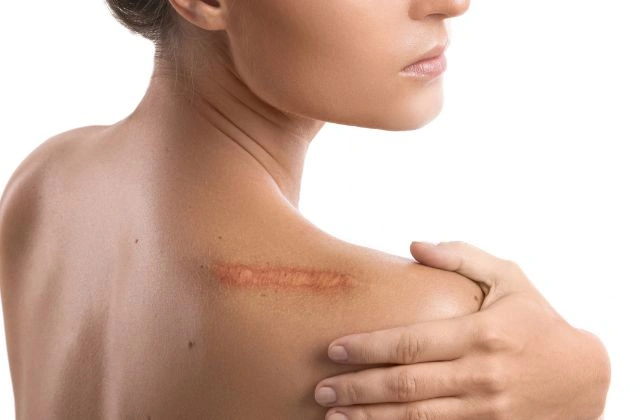
“Can anything be done about this?”
We hear that question a lot. It usually comes with a rolled-up sleeve, or someone pulling their collar aside to show us. A bike accident from college. A caesarean scar that healed thick. A burn from a kitchen accident years ago that has tightened so much they can’t fully straighten their arm anymore.
Usually, yes, we can do something. Scar revision surgery in Kozhikode is a regular part of our practice, though the results may not be quite what people picture.
You can’t erase a scar.
We’d rather say this up front. Any cut in the skin leaves a scar, including the one we make to fix an old one. So scar revision surgery isn’t about making a scar vanish. It’s about trading a scar that bothers you for a better one: thinner, flatter, softer, better aligned, or no longer pulling on the surrounding skin.
For many people, that’s more than enough.
Why did my scar heal like this?
Honestly, it’s often just luck. Two people can get the same cut and heal completely differently. A deep wound, an infection, or skin that was stretched while healing all make things worse. Scars on the chest, shoulders and over joints tend to misbehave. And some people’s skin simply scars more easily than others’. It’s not something you did wrong.
What kind of scar is it?
This matters because each type is handled differently.
A scar that’s raised and red but stays inside the original wound is hypertrophic. It’s irritating, often itchy, but many of these calm down on their own if you give them a year or two.
A keloid is another story. It doesn’t stop at the edge of the wound. It keeps growing, sometimes far bigger than the injury that started it, and earlobes, the chest and the shoulders are favourite spots.
Then there are contractures, which we see most often after burns. The scar shrinks as it matures and pulls the skin tight. Over an elbow, the fingers or the neck, that means you can’t move normally. Treating these is less about appearance and more about getting your movement back.
And some scars just healed badly: wide, dented, uneven, or running across the natural lines of the skin so they catch the light.
How scar revision surgery works.
Sometimes it’s as simple as cutting out the old scar and closing the skin again, carefully, in layers, so it heals finer.
If the scar is tight or sits at an awkward angle, a technique called Z-plasty lets us lengthen it and turn it to follow the skin’s natural creases. For a long straight scar, a W-plasty breaks it into a small zigzag. Strange as it sounds, the eye skims over an irregular line much more easily than a straight one.
Bad burn contractures need more. We release the tight band, then fill the gap that opens with healthy skin, as a graft or as a flap moved from nearby. That’s often the step that gives someone the use of their hand back.
A lot of scars never need an operation, though. Silicone gel or sheets, pressure garments (a big part of burn care), steroid injections and laser can do a great deal on their own, or support a surgical result.
Keloids are the exception. Cut one out and do nothing else, and there’s a real chance it returns, sometimes bigger. So we almost always combine keloid surgery with other treatment, such as steroid injections.
Sometimes the best advice is to wait.
People don’t expect a surgeon to say this. Scars take a long time to settle, usually 12 to 18 months. They start red and firm and slowly go pale and soft. Operating in the middle of that means working on tissue that’s still changing. So unless a scar is restricting movement, we often suggest silicone or pressure treatment first, and we look at it again once it has matured.
Recovery tends to be easier than people fear. After a straightforward revision, most people are back to normal within a few days, and the stitches come out after a week or two. Burn reconstruction with grafts or flaps takes longer, and physiotherapy is usually part of it. In every case, the new scar needs months to mature, so the final result doesn’t show right away.
Should you get yours checked?
If it’s thick, growing, itchy, painful or tight, yes. If it’s stopping you from moving a joint, definitely. Burn scars are worth seeing early, since pressure garments work best when started soon. And if a scar just makes you self-conscious, that’s reason enough.
When you come in, Dr Krishna Kumar K. S. will look at the scar, ask how it happened and what you’ve already tried, and go through your medical history. Then we’ll talk frankly about what you’re hoping for and what’s realistic for that particular scar. Sometimes the plan is surgery. Sometimes it’s “come back in six months”. Either way, you’ll know where you stand.
Scar treatment is a regular part of our work in skin surgery and burns care, so there’s nothing unusual about asking. If you’re looking for an experienced Plastic Surgery Doctor in Kerala to take a look at an old scar, we’re happy to help.
Questions patients often ask us.
Can you remove my scar completely?
No, and be wary of anyone who says they can. What we can do is make it finer, flatter and much easier to live with.
Will it hurt?
Most revisions are done under local anaesthetic, so the procedure itself isn’t painful. Expect a few sore days afterwards; regular painkillers are usually enough. Bigger burn operations may need general anaesthesia.
How long should I wait?
Twelve to eighteen months, generally. Sooner if the scar is limiting movement.
Will my keloid come back?
It might. That’s why we treat keloids with surgery plus other treatments, not surgery alone.
Have a scar you’d like to get checked? Consult with Dr Krishna Kumar K S for expert guidance on scar revision surgery in Kozhikode and personalised treatment options. Contact us to book your consultation.