

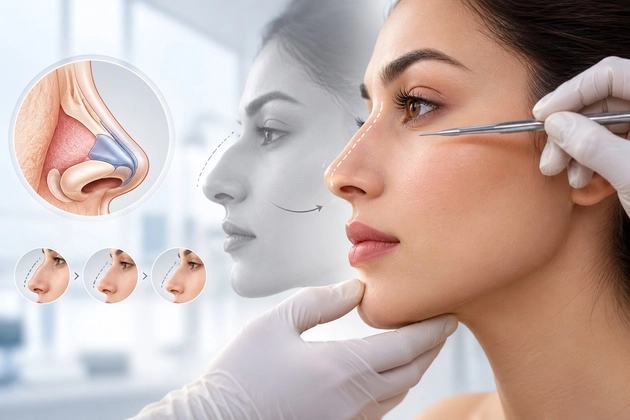
Thinking about a nose job? Rhinoplasty reshapes the nose to change how it looks, how you breathe, or both. Here’s how it works in Kozhikode, what recovery is really like, and what affects the cost, from Dr. K.S. Krishna Kumar, a plastic surgery doctor in Kerala.
What is rhinoplasty, and who is it for?
Rhinoplasty is surgery that reshapes or reconstructs the nose for cosmetic or medical reasons. It’s one of the most popular procedures in cosmetic surgery and part of the facial procedures Dr. Krishna Kumar offers. Some people want a nose that looks more balanced with the rest of their face. Others need help with a breathing problem, an old injury or a difference they were born with. Plenty of people have a bit of both.
You might be a good candidate if:
- You’re unhappy with a bump, a wide bridge, a drooping tip, or a nose that looks out of balance with your face.
- Your nose was hurt in an accident and healed crooked or blocked.
- You have a deviated septum or trouble breathing that medicines haven’t fixed.
- You’re healthy, you don’t smoke (or can stop before and after surgery), and your face has finished growing. That’s usually around 15 to 16 for girls and 17 to 18 for boys, and your surgeon will confirm it.
- Your expectations are realistic. The goal is a natural, balanced nose, not a copy of someone else’s.
Types of rhinoplasty
Which approach is right depends on your nose, your goals and what your surgeon finds when they examine you.
- Open rhinoplasty. The surgeon makes a small cut across the columella, the strip of skin between your nostrils, and lifts the skin to see the nasal structure directly. It suits more complex reshaping, tip work and revision cases.
- Closed rhinoplasty. Every cut is made inside the nostrils, so there’s no outside scar. That isn’t possible for every nose, though. It suits smaller changes, like taking down a bump.
- Functional rhinoplasty (with septoplasty). This one is about breathing. The surgeon straightens the septum and opens the airway, which is what you’d need for breathing difficulty, a deviated septum or an injury.
- Revision rhinoplasty. If an earlier nose surgery left you unhappy, or affected your breathing, a revision corrects the result.
- Non-surgical rhinoplasty. Injectable fillers can smooth small bumps or lift the tip for a while, with no surgery. It’s for minor changes only, and results last roughly 6 to 12 months. See our non-surgical procedures for Botox and fillers.
How the procedure works
Most rhinoplasties take about one and a half to three hours, depending on how much needs to be done.
- Consultation. Your surgeon examines your nose, asks what you’d like to change, goes through your medical history and explains what’s realistic. Photographs of your nose are taken from several angles.
- Anaesthesia. Most rhinoplasties are done under general anaesthesia. Some smaller ones use local anaesthesia with sedation.
- Reshaping. Working through open or closed incisions, the surgeon reshapes bone and cartilage as planned: smoothing a bump, refining the tip, narrowing the bridge or straightening the septum.
- Closing and support. The skin is repositioned and stitched. A splint goes on the nose, and soft packing or internal splints may be used.
- Going home. Many patients go home the same day or after one night in hospital, as the surgeon advises.
What recovery looks like
Most people are back at a desk in about one to two weeks, but your nose keeps settling for a year or more. The timings below are typical, and everyone heals a little differently.
- Days 1 to 3: Expect swelling, mild pain, a blocked nose and some bruising around the eyes. Rest with your head raised, take your prescribed medicines and don’t blow your nose.
- Day 7 to 10: The splint comes off, and the bruising starts to fade. You’ll have a follow-up visit, and you can ease back into gentle daily routines.
- Weeks 2 to 3: Most of the visible bruising and swelling settles. If your surgeon agrees, you can go back to desk work. Skip contact sports and heavy exercise for now.
- Weeks 4 to 6: Breathing improves,s and the nose looks more settled. Your surgeon will tell you when most activities can resume.
- Months 3 to 6: Swelling in the tip slowly goes down. Protect your nose from knocks and strong sun.
- 12 months: The final shape becomes clear, and your surgeon does a last review with you.
Mayo Clinic advises against resting eyeglasses or sunglasses on your nose for at least four weeks after surgery, since they can put pressure on it. Your surgeon will tell you how long it applies to you and suggest alternatives.
How much does rhinoplasty cost in Kerala?
The cost of rhinoplasty depends on the individual case, so there is no fixed price. For accurate information about the cost for your nose, please contact the clinic or call +91 8157 822 822 to book a consultation with Dr. Krishna Kumar, where your needs can be assessed and an estimate explained.
A few things shape the final bill:
- How complex the surgery is. Taking down a small bump costs less than full reshaping, septum correction or revision surgery.
- Who operates. A surgeon with specialist training and long experience may charge more, but cost shouldn’t be the only thing you weigh when choosing who operates on your nose.
- Where it’s done. Operation theatre fees, room category and length of stay all add up.
- Anaesthesia. General anaesthesia costs more than local anaesthesia with sedation.
- Tests, medicines and follow-up. Ask what’s included: pre-operative tests, dressings and post-operative visits.
- Insurance. Cosmetic rhinoplasty is usually not covered. Surgery done mainly to correct breathing, such as septoplasty, may be covered as a medical procedure, depending on your policy and its exclusions. Check with your insurer first.
Tip: Ask for an itemised estimate, and be wary of unusually cheap offers.
The risks, and what’s realistic
Rhinoplasty is one of the most popular cosmetic surgeries, but like any operation, it carries risks. They include:
- Bleeding, infection or a reaction to the anaesthesia
- Swelling that lingers, numbness or visible scarring
- Trouble breathing, or a feeling of blockage
- Asymmetry, or a result that doesn’t match what you hoped for
- Needing a revision procedure in some cases
A careful assessment, a clear surgical plan and good follow-up lower the risk. Still, results can’t be guaranteed, and no surgeon can promise a specific outcome. A good one will tell you honestly what’s achievable with your nose, your skin thickness and your facial structure. If a scar from an injury or an earlier surgery bothers you, scar revision can be discussed separately.
What about other facial procedures?
A face is more than a nose, so some patients ask about other treatments at the same visit. The facial procedures Dr. Krishna Kumar offers include facelift, eyelid surgery (blepharoplasty), chin and cheek augmentation, lip enhancement and otoplasty (ear surgery). Whether any of these should be combined with rhinoplasty, or done at a different time, is decided after your surgeon examines you. For more background, read about the difference between plastic surgery and cosmetic surgery and things you should know about cosmetic surgery.
How to choose a rhinoplasty surgeon in Kozhikode
Your nose is small, but it has a big effect on how you look and how you breathe. So the surgeon matters more than the price. Here are some questions worth asking before you decide:
- Is the surgeon a qualified plastic surgeon with an MCh or equivalent specialist degree in plastic surgery? (Here’s the difference between plastic and cosmetic surgery.)
- How many rhinoplasties does the surgeon do each year?
- Can you see real before-and-after photographs of similar noses (with patient consent)?
- Will the surgeon talk honestly about risks, and say no when surgery isn’t the right choice?
- Where will the surgery take place, and is it a properly equipped hospital with anaesthesia support?
- What follow-up care is included, and what happens if you need a revision?
About Dr. Krishna Kumar. Dr. K.S. Krishna Kumar did his MBBS and MCh (Plastic Surgery) at Trivandrum Medical College and his MS (General Surgery) at KMC Mangalore. He then trained in the UK, where he earned FRCS (Plastic Surgery), was awarded the CCT and entered the UK Specialist Register in Plastic Surgery. A Hand and Microsurgery fellowship followed at the Christine M. Kleinert Institute in Louisville, USA. Back in India, he set up the first modern plastic surgery unit in Malabar, and he has served as Cluster HOD and Senior Consultant in Plastic Surgery with the Aster group of hospitals in Kerala. He is also a past President of the Kerala Plastic Surgeons Association.
His work in microvascular surgery and cleft and craniofacial surgery involves delicate facial work, including cleft lip-nose surgery for nasal deformities linked to cleft lip. He has also co-authored research on nostril base (alar base) symmetry after cleft lip and palate repair. That background in careful facial reconstruction is relevant when planning a nose job for both appearance and function.
Questions patients ask
How long does rhinoplasty take? Usually about one and a half to three hours, depending on the changes planned.
Is rhinoplasty painful? You won’t feel pain during surgery. Afterwards, most people describe pressure and a blocked feeling more than sharp pain, and the medicines you’re given keep it manageable.
When can I go back to work? Most people with desk jobs return after one to two weeks. Physical work and sport take longer. Your surgeon will advise based on your case.
When will I see the final result? You’ll see the new shape once the splint comes off, but swelling hides the finer detail for months. The final result can take up to a year to appear.
Will there be visible scars? Closed rhinoplasty leaves no visible scar. Open rhinoplasty leaves a tiny scar across the columella, which usually fades well.
Can rhinoplasty improve my breathing? Yes, when the surgery includes correcting a deviated septum or narrowed airways. Tell your surgeon about any breathing problems at the consultation.
What is the best age for a nose job? Once the nose has stopped growing: usually around 15 to 16 for girls and 17 to 18 for boys, as confirmed by the surgeon. There’s no fixed upper age limit if you’re healthy.
Is non-surgical rhinoplasty a good alternative? It suits small changes, like a minor bump or a slightly low tip, and the results last roughly six months to a year. It can’t make the nose smaller or fix breathing problems. Learn more about our non-surgical procedures.
I live outside Kozhikode. How long should I plan to stay? Plan to stay in or near the city for about a week to ten days, until the splint comes off at your follow-up visit, and confirm the timing with Dr. Krishna Kumar. He started health tourism services for patients travelling for cosmetic and reconstructive procedures. You can contact the clinic to plan your visit.
Plan your consultation
A good rhinoplasty starts with an honest conversation about what you want and what’s possible. If you’re considering a nose job in Kozhikode, book a consultation with Dr. K.S. Krishna Kumar. He’ll examine your nose, answer your questions and explain your options, with no pressure to decide. You can also look through our cosmetic surgery services or watch videos with Dr. Krishnakumar explaining common procedures.
Call +91 8157 822 822 or request an appointment.